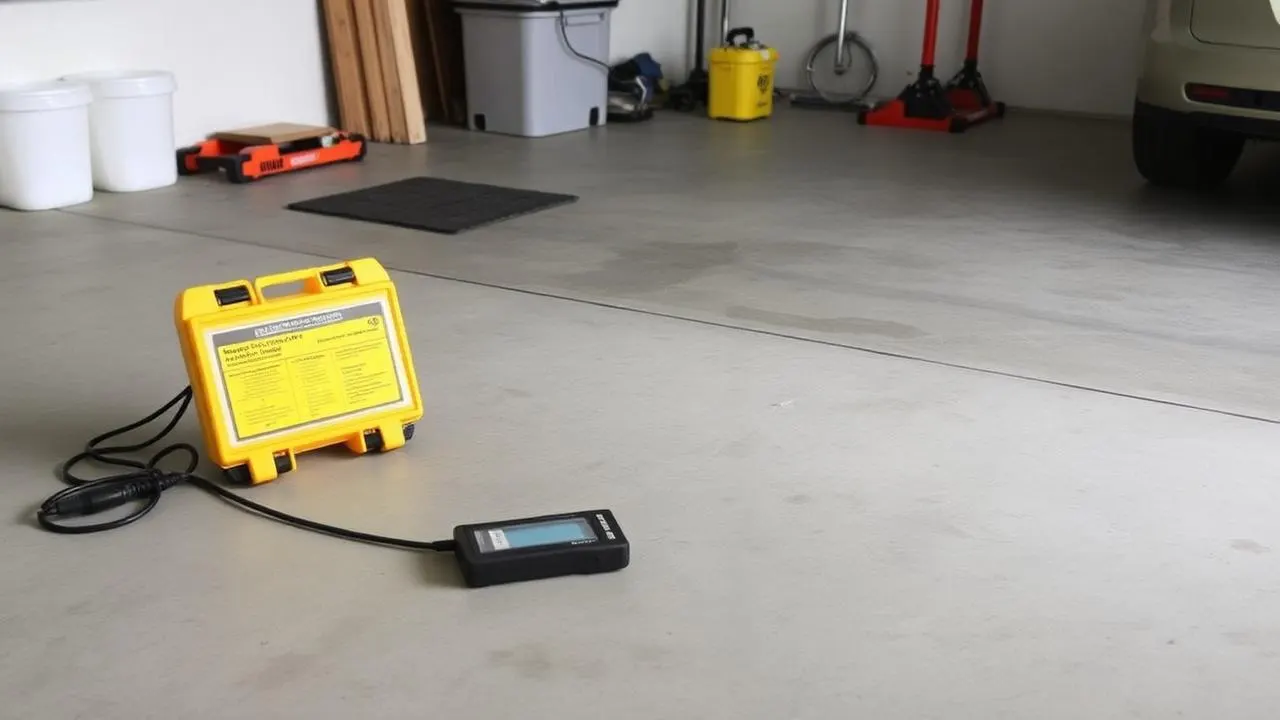
Concrete Moisture Testing: Why It's Non-Negotiable
Ready to get started?
Call (904) 300-1558 or request a free, no-obligation quote — we typically respond the same day.
Concrete Moisture Testing: Why It's Non-Negotiable
Skipping moisture testing is the single biggest reason floor coatings fail in Florida. Here's the science behind the test.
We've touched on moisture testing in several articles, but it deserves its own deep dive because moisture is the #1 cause of coating failure in Florida. If your installer isn't testing for moisture, walk away.
The Science
Concrete is like a rigid sponge — it's full of microscopic pores and capillaries. Water moves through these pathways via capillary action and vapor diffusion. In Florida, where the water table is often just a few feet below the surface, moisture is constantly migrating upward through the slab.
This moisture vapor creates hydrostatic pressure at the concrete-coating interface. When this pressure exceeds the coating's adhesion strength, the coating lifts off. It's physics, not bad luck.
The Two Standard Tests
ASTM F1869 — Calcium Chloride Test
A dish of anhydrous calcium chloride (a powerful desiccant) is sealed to the concrete surface for 60-72 hours. The weight gain of the calcium chloride tells us the moisture vapor emission rate (MVER).
Acceptable levels:
- Most epoxy systems: < 3 lbs/1,000 sq ft/24 hours
- Some moisture-tolerant systems: < 5 lbs
Limitations: Only measures surface moisture, not internal slab conditions. Can give misleading results if the concrete was recently sealed or cleaned.
ASTM F2170 — Relative Humidity Test (Preferred)
Small holes are drilled into the slab at 40% of the slab depth. Calibrated RH probes are inserted and allowed to equilibrate for at least 72 hours. The probes measure the internal relative humidity of the concrete.
Acceptable levels:
- Most epoxy systems: < 75% RH
- Moisture-mitigating primers: can handle up to 95-99% RH
Advantages: More accurate, measures internal conditions, less affected by surface treatments.
What Happens If Moisture Is Too High?
You have three options:
- Wait — Allow the slab to dry out (can take weeks or months; not practical for occupied buildings)
- Apply a moisture mitigation system — Specialized epoxy primers designed to block vapor transmission
- Install a vapor barrier — A membrane system that creates an impermeable barrier between the slab and coating
We prefer option 2 or 3, depending on the severity of the moisture issue. Our approach to moisture management is one of the key differences between our installations and cut-rate competitors. Read our comparison in epoxy vs polyurea.
Red Flags
If a flooring contractor:
- Doesn't mention moisture testing → 🚩
- Uses only the "plastic sheet test" (duct-taping plastic to the floor) → 🚩 (This is a screening test, not a quantitative measurement)
- Says "concrete looks dry, we're fine" → 🚩🚩🚩
- Doesn't own moisture testing equipment → 🚩🚩🚩🚩
There are multiple threads on Reddit from homeowners who learned this lesson the hard way.
Don't risk it. Contact us and we'll test your slab properly.
Frequently Asked Questions
Ready to Transform Your Floor?
Get a free, no-obligation quote for your project in Jacksonville, St. Augustine, or Palm Coast.
Request a Free Quote