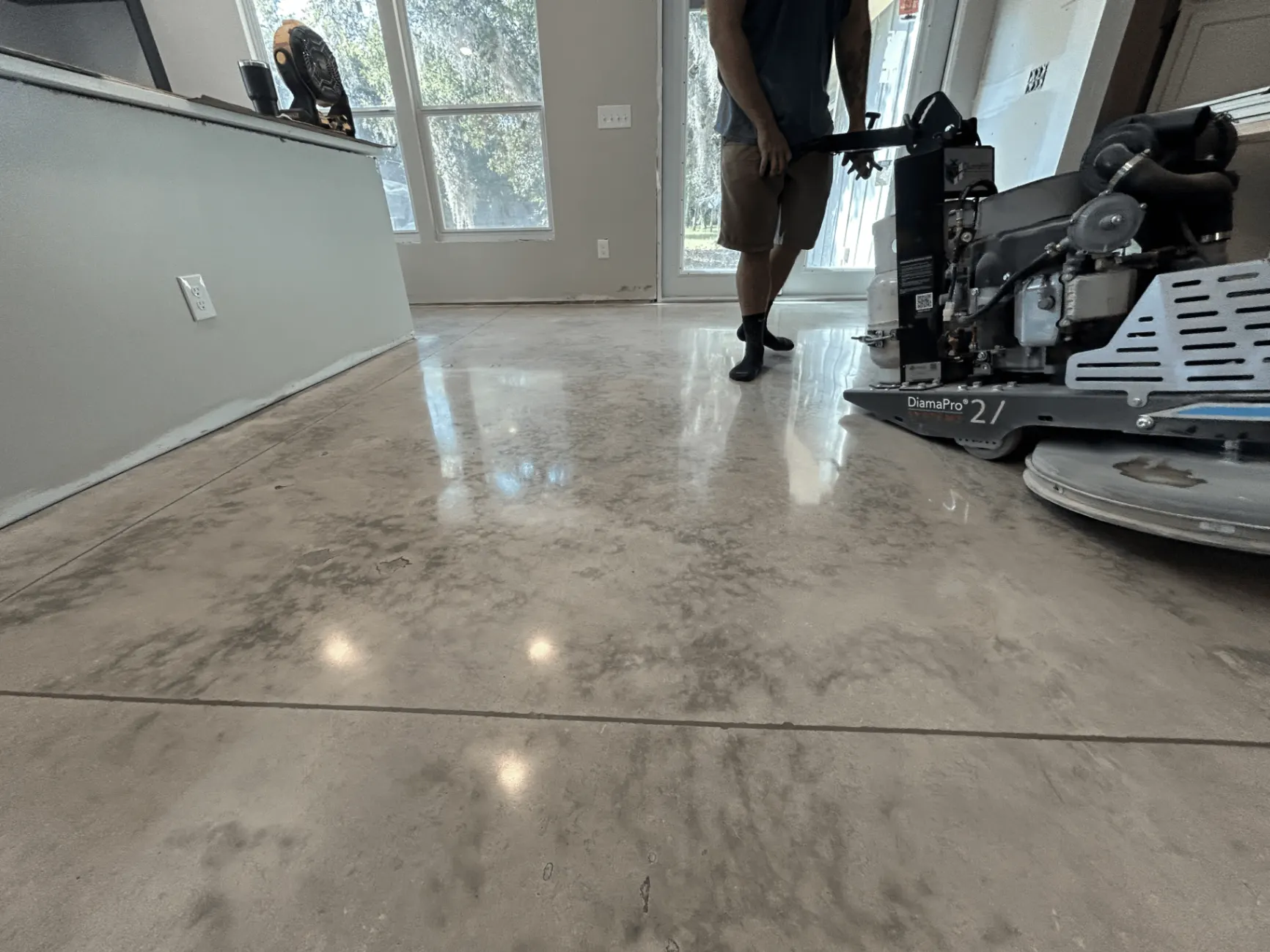
Concrete Polishing in Jacksonville & St. Augustine, FL
Mechanical Diamond Polishing · Natural Concrete · Your Choice of Sheen
What is Concrete Polishing, and where does JAX Epoxy Floors offer it?
JAX Epoxy Floors mechanically grinds, densifies and polishes existing concrete for homes and businesses in Jacksonville, St. Augustine and Northeast Florida. Residential coatings carry a Lifetime Warranty; polished concrete is a different finish, so ask us about the coverage appropriate to your project. Request a free quote at (904) 300-1558 to compare exposure, sheen and preparation for your slab.
Ready to get started?
Call (904) 300-1558 or request a free, no-obligation quote — we typically respond the same day.
Polished concrete turns the existing slab into the finished floor rather than hiding it under a thick decorative resin. Diamond tooling removes weak surface material and progressively refines the concrete; a densifier hardens the cement paste, and a compatible guard helps with stain resistance. The final appearance reflects the original placement, aggregate, repairs and grinding depth. Those details are part of the design conversation, not defects that a high-gloss finish automatically conceals.
If you are looking for concrete polishing near me, start with a slab assessment rather than a photograph of another floor. Polished concrete in Jacksonville can suit a contemporary interior, a showroom or a working warehouse, while polished concrete in St. Augustine may involve an older slab with previous finishes. We discuss actual traffic, moisture, cleaning and lighting before recommending an exposure and sheen. A small test area helps set realistic expectations where concrete history is uncertain.
Benefits
- Uses suitable existing interior concrete
- Cream, salt-and-pepper or aggregate exposure
- Matte, satin and higher-gloss options
- Routine care with dust removal and neutral pH cleaning
- Finish selection for homes, showrooms and working floors
Get a Free Quote for Concrete Polishing
Pricing, timeline, and next steps back to you within 24 hours.
How does our concrete polishing process work?
1. Assessment and moisture testing: we inspect slab soundness, old coatings, stains, flatness and traffic requirements. Moisture testing informs the finish and any guard or sealer specification. Polishing does not correct water entry, drainage problems or structural movement. New concrete also needs assessment; a recent pour is not automatically ready for the chosen finish.
2. Crack and joint repair: stable cracks, pits and damaged edges are evaluated and repaired as appropriate. Joints remain part of the floor's movement strategy rather than being indiscriminately bridged. Repair material may look different from surrounding concrete after polishing, so visible repairs and their likely appearance should be discussed before grinding begins.
3. Diamond grinding: metal-bond tooling removes surface material and establishes the agreed exposure. The slab's hardness and starting condition determine the tooling, passes and edge work. Deeper aggregate exposure takes more removal than a cream finish, and an uneven slab can expose aggregate inconsistently even within the same room.
4. Densifier: a compatible chemical densifier reacts with the cementitious surface to improve hardness and reduce dusting. Its application point and dwell requirements follow the selected system and the slab's response. Densifier is not a waterproof membrane and is not a substitute for resolving contamination or moisture problems.
5. Honing and polishing: successively finer diamond abrasives refine the earlier scratches and develop the selected sheen. Edges and transitions need attention alongside the open floor. We choose the stopping point around use and appearance rather than assuming every floor needs a mirror finish.
6. Guard or sealer and handover: where specified, a compatible protective treatment improves resistance to everyday spills. It must suit the polished surface and intended traffic. We discuss cleaning, spill response and any future refresh or burnishing requirements; the guard does not make the concrete immune to stains or chemical attack.
What grit and sheen levels can you choose?
An illustrative progression uses 50, 100 and 200 metal-bond grits before resin stages such as 400, 800, 1500 and 3000. This is a discussion guide, not a fixed recipe: tooling manufacturers use different systems, and transition abrasives may be needed between metal and resin stages. Concrete hardness and scratch removal determine the practical sequence. Grit numbers describe tooling; they do not independently guarantee a measured gloss result.
A lower-sheen honed finish gives a restrained, more diffuse appearance. Satin brings some reflection without a strong mirror effect, while higher resin stages can develop a more reflective surface. View a sample in the actual room because windows, overhead lighting and aggregate all influence the impression. Gloss is not a slip rating: wet contamination, footwear, maintenance and the final protective treatment matter too.
Cream, salt-and-pepper or aggregate exposure?
Cream exposure preserves as much of the surface paste as the slab allows, producing a quieter appearance with little visible stone. It requires a suitable surface; removing old adhesive, coatings or damage can make a cream result impractical. Salt-and-pepper exposure reveals fine aggregate and gives a lightly speckled finish. Aggregate exposure removes more paste to reveal larger stones and a more pronounced texture in the visual pattern.
Exposure and sheen are separate choices. An aggregate floor can be honed rather than highly glossy, and a fine-exposure floor can be reflective. The original slab controls the stone color, distribution and potential variation. Patches, pour boundaries and edges may remain visible. Agree on a test area when a consistent exposure is important rather than expecting existing concrete to resemble a manufactured tile.
Where does polished concrete work best?
Garages and workshops benefit from evaluating oil history, wet tires and the need for texture before choosing polishing over a coating. Homes and interior living spaces can use the natural slab as a continuous visual surface, but furniture protection, existing repairs and transitions to adjoining rooms need planning. Concrete remains a hard floor; a glossy look does not add cushioning or insulation.
Retail and showrooms often prioritize light reflection, a clear floor layout and everyday cleaning. Warehouses and industrial spaces place more emphasis on joint condition, rolling loads, dust control and exposure to spills. Polishing may suit dry traffic areas, while wet processing or aggressive chemicals can call for a specified industrial coating. We compare the actual zone rather than treating an entire building as one use.
What matters for concrete polishing in Florida?
Northeast Florida humidity can contribute to condensation when warm moist air meets a cooler floor. Slab moisture is a separate issue and needs appropriate assessment; a dry-looking surface does not establish that a topical treatment is suitable. Densified concrete is not a vapor barrier. Resolve ongoing water entry before expecting a decorative floor to perform predictably.
Near the coast, salt residue and tracked-in sand increase the importance of entry mats and regular cleaning. Salt air proximity alone does not determine a slab specification. Heat, open garage doors and sudden rain change how a floor is used and cleaned, while direct sun affects lighting and some color treatments. Fully exposed patios and pool surrounds need a separate exterior finish discussion rather than an automatic interior-polish specification.
How do you maintain polished concrete?
Remove grit regularly with a clean dust mop or suitable vacuum. Damp mop with a neutral pH cleaner compatible with the guard, and collect spills promptly. Acidic or aggressive cleaners can etch concrete or damage protective treatments; stronger detergent is not automatically better. Keep entry mats clean and use appropriate pads beneath furniture and equipment.
Busy floors may need machine cleaning with compatible pads and, when the finish system calls for it, re-burnishing or a guard refresh. Schedule these by wear, traffic and the product's guidance, not a universal calendar promise. A loss of clarity may come from dirt or detergent residue rather than wear, so inspect and clean before deciding that the entire floor needs repolishing.
Polished concrete vs epoxy: which fits your floor?
| Consideration | Polished concrete | Epoxy |
|---|---|---|
| Durability | Refines the existing concrete; joints, surface wear and slab damage still matter. | A resin wear layer; preparation, coating build and traffic determine performance. |
| Slip | Sheen alone is not a slip rating; assess wet use and contamination. | Texture can be specified; wet spills and cleaning still affect traction. |
| Look | Natural paste, stone, repairs and pour variation remain visible. | Solid, metallic or flake finishes can change the slab's visual appearance. |
| Moisture | Not a vapor barrier; protective treatments still need moisture assessment. | Bonding requires moisture conditions within the selected system's limits. |
| Maintenance | Dust mop, neutral pH cleaning and treatment-specific burnishing or guard care. | Remove grit, clean spills and follow coating-specific care instructions. |
| Best uses | Suitable interiors, showrooms and dry warehouse traffic areas. | Garages, decorative interiors and use-specific commercial or industrial zones. |
Quality Guaranteed
Every concrete polishing installation is backed by our quality guarantee. We stand behind our work — from surface preparation to final clear coat.
Concrete Polishing FAQ
Concrete Polishing Near You
- Concrete Polishing in Jacksonville, FL
- Concrete Polishing in St. Augustine, FL
- Concrete Polishing in Ponte Vedra Beach, FL
- Concrete Polishing in Nocatee, FL
- Concrete Polishing in St. Johns, FL
- Concrete Polishing in Fruit Cove, FL
- Concrete Polishing in Julington Creek, FL
- Concrete Polishing in Jacksonville Beach, FL
- Concrete Polishing in Orange Park, FL
- Concrete Polishing in Fleming Island, FL
- Concrete Polishing in Palm Coast, FL