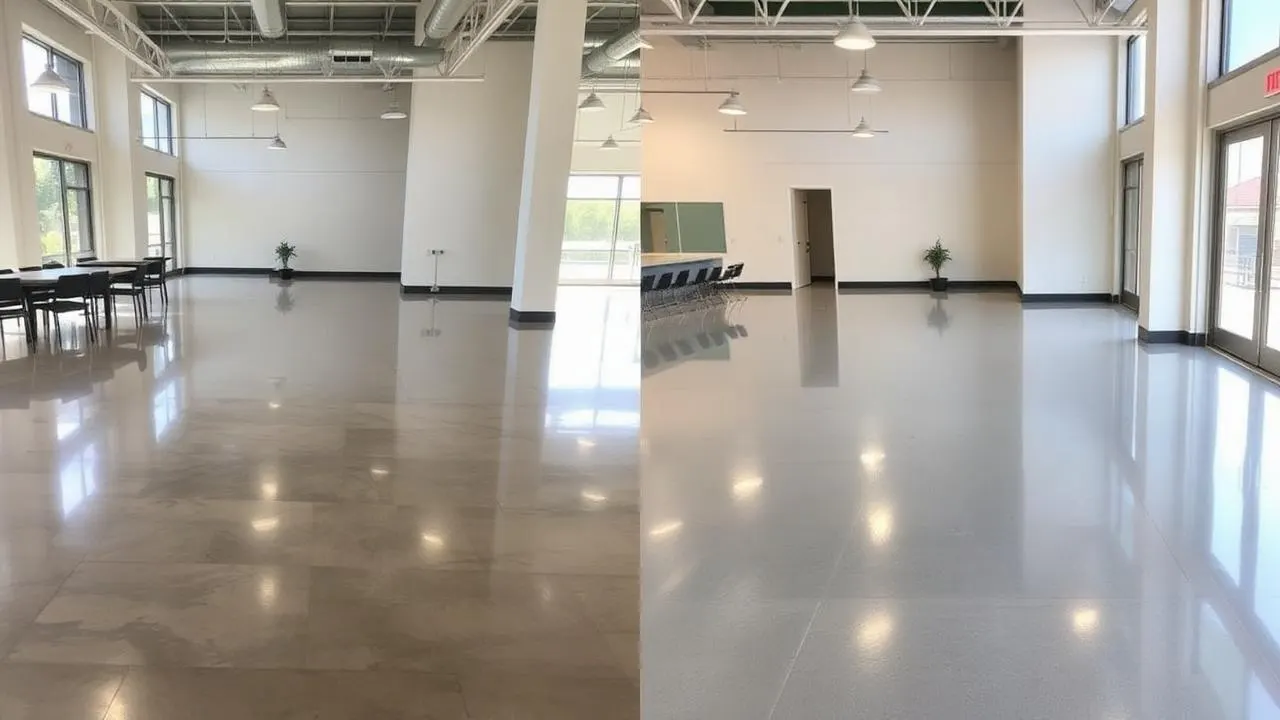
Concrete Polishing vs Epoxy: Which Is Right for You?
Ready to get started?
Call (904) 300-1558 or request a free, no-obligation quote — we typically respond the same day.
Concrete Polishing vs Epoxy: Which Is Right for You?
Both options transform concrete floors, but they serve very different purposes. Here's a detailed comparison.
Polished concrete and epoxy coatings are both excellent flooring solutions, but they work in fundamentally different ways and serve different purposes. Choosing the wrong one for your application can lead to disappointment and wasted money.
How They Work
Polished Concrete
Polished concrete is not a coating — it's a refinement of the existing concrete surface. Through a multi-step process of progressively finer diamond grinding, the concrete itself is transformed into a dense, glossy surface. A chemical densifier (typically lithium silicate) is applied to harden and seal the pores.
The result is a floor that looks like polished stone, with a natural beauty that comes from the concrete itself. Read more on our concrete polishing service page.
Epoxy Coating
Epoxy is a separate material (a two-part resin system) that's applied on top of the concrete. It creates a distinct layer — typically 15-25 mils thick — that protects the concrete beneath. Epoxy can be clear, solid-colored, metallic, or decorated with color flakes.
Side-by-Side Comparison
| Feature | Polished Concrete | Epoxy Coating |
|---|---|---|
| Appearance | Natural stone look | Customizable (flake, metallic, solid) |
| Thickness | No added thickness | 15-25+ mils |
| Slip resistance | Low (can be slippery when wet) | High (with flake or anti-slip additive) |
| Chemical resistance | Moderate | High |
| Stain resistance | Good (with sealer) | Excellent |
| Maintenance | Very low | Low |
| Repair | Can be re-polished | Requires recoating |
| Best for | Retail, offices, restaurants | Garages, warehouses, kitchens |
| Installation time | 2-5 days | 2-4 days |
When to Choose Polished Concrete
- Retail spaces where you want a sophisticated, natural look
- Restaurants and breweries where the industrial aesthetic is desired
- Large open areas like lobbies and conference rooms
- Spaces with radiant heat flooring — polished concrete conducts heat efficiently
- When you want minimal ongoing maintenance
When to Choose Epoxy
- Garages where chemical spills, hot tires, and impacts are common
- Warehouses and industrial spaces that need maximum chemical resistance
- Commercial kitchens that need slip resistance and easy cleaning
- When you want customizable colors and patterns
- Spaces prone to moisture issues (epoxy with a vapor barrier manages this better)
Can You Combine Them?
Not really. Epoxy doesn't bond well to polished concrete because the surface is too smooth. If you want a coating on your floor, skip the polishing. If you want the polished look, skip the coating. They're distinct paths.
Our Recommendation
For residential garages and workshop spaces, we almost always recommend color flake epoxy. For commercial spaces where aesthetics are paramount and chemical exposure is minimal, polished concrete delivers a timeless look that's hard to beat.
Not sure which is right for your space? Let us help you decide.
Frequently Asked Questions
Ready to Transform Your Floor?
Get a free, no-obligation quote for your project in Jacksonville, St. Augustine, or Palm Coast.
Request a Free Quote